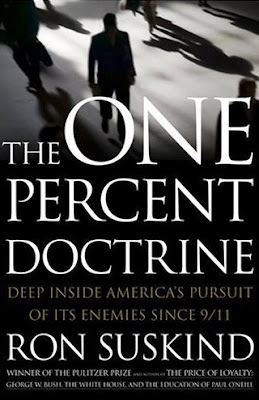
The full title is
The one percent doctrine: Deep inside America’s pursuit of it’s enemies since 9/11.
The book reads like an information overload. It is like the best spy novel you have ever read, expect it isn’t fiction. You wish it were fiction.
Suskind picks up the story in the August before 9/11 when the CIA interrupted George W. Bush’s long vacation to warn him of the imminent threat to the country. Of course Bush had been warmed of the threat since before he took office. Over a year later, and with intelligence all of the world, especially the Middle East, saying that America was going to be attacked, George Bush told George Tenet and the CIA, OK, you have covered your ass, and went back to his vacation. Bush did nothing. (This meeting has been reported by many sources, and George Bush talked about it his interview with Bob Woodward)
After the attacks many things happened. George Bush saved CIA director George Tenet job, and thereby owning Tenet. A series of policies were put into place on how conduct the new war against terrorism. Dick Cheney put forth the One Percent Doctrine. This stated that there if there was even a one percent chance that something could threaten the United States, the government must act as if the country was certain to be attacked. This idea threw out analysis and evidence.
Cheney and Rumsfeld made sure that CIA had all the weapons it needed to fight this new war. This included torture and wire-tapping. The funny thing is that these measures have been used since the start of the CIA. The old rule used to be if it is isn’t public then it is legal. (A History of the CIA by Tim Weiner). The Bush administration went to great lengths to make it legal, even with great costs to the country’s collateral. I am not sure you can say that the difference is scale, because during the Cold War all mail that went out of the United States was searched. It begs the question that this insistence, to make it all legal was less about fighting terrorism than it was about gaining revenge for two men who were burnt by the Watergate era and wanted payback; to put the country where they thought is belonged.
The idea was that the United States would never be caught off guard again is the rational for these new measures. Of course, if the Administration would have just listened to its intelligence, maybe 9/11 could have been avoided. Al Gore, in
The Assault on Reason suggests that if the government had just followed their leads, all the terrorists could have been caught using public records and know lists. Of course, the CIA, FBI and other government organization have a long disastrous history of not talking to each other. One the best things that the Bush administration has done, is not tolerate such behavior, which is the first time in history. The idea was that the FBI was fight terror at home and the CIA overseas, and that effectively worked.
The story really starts when Libya decided that it wanted to join the world community again. (Check out current news, i.e. Libyan meeting with the new French President). It had been alienated since the Reagan Administration for terrorist actions. Now a Libyan representative met with the CIA at the Hyde Park, London home of a Saudi Prince. He gave as an offering one name. The CIA took it and found that person in Pakistan. Working with Pakistani authorities that capture him and more importantly a computer, a diary and other important information.
Now like most things in the past few years, once American agencies have an opportunity to do their job right, they do, and they do it great. Unfortunately, the ideologues in the Administration, like Rumsfeld, get a hold of information and they filter it through fantastic and unrealistic view of how the world works and they screw everything up.
Now from here on, the story goes in two directions. One is the CIA success from that seed that of the original Libyan contact, and the other is the political story of the Administrations war on Terror. The CIA/FBI investigation went great. The seed lead to more and more information and arrests. Their money systems tapped. The U.S. was everywhere they raised their head. At the same time torture such as water boarder was being used those capture those who had to no knowledge anything, and those who were mentally unstable, although you have to wonder about the mental stability of all these people who are out to do so much harm. Nevertheless, things were said do to the torture that were untrue. However, because of the One Percent Doctrine everything had to be taken as a threat even though there no possible way these wild stories could be taken seriously. So what happened was that resources were spent chasing nothing. These stories of terrorist plots everywhere came mainly from one unstable man during torture. Evidence had to be thrown out due to directives from the highest level of government. American threat levels were constantly going up and down. This is why.
In fact, the combatants were trained and expect torture (so the argument that talking about American torture is giving intelligence to the enemy is complete nonsense), what they weren’t expecting of the FBI’s technique of doing favors. The FBI even went so far as to get someone’s wife for him from Pakistan and the wife told him that he better tell the U.S. what they wanted to know. Most who experience such treatment told the U.S. want they wanted to here. What the ideologues don’t understand is the history of the United States. They only knew the propaganda and the bravado. People from most countries expect to be tortured or spied on. It doesn’t help to be just as bad as the worst dictators. What worked for the U.S. in World War was that the Germans knew that the American were the most humane of all the Allies. They really didn’t want to be captured by the Russian, because they knew death would be better. German soldiers and citizens more easily surrender and cooperated with the American because they knew that the American would be just to them. (Source Stephen Ambrose ‘Citizen Soldier’).
Politics and reality become very confusing. As old and never followed through plots were uncovered were released to the press as if it they were current threats at prime periods during the 2004 Presidential elections, it would push the public towards President Bush. He ran on the premise that he had kept America Terror free. Even Bin Laden got in on the election. By making an appearance Bin Laden almost sealed the presidency for George W. Bush. It was clear that Bin Laden wanted Bush in the White House.
But it asks the question why hadn’t American been hit by a terrorist attack. To CIA the answer was that maybe they didn’t want to hit America again. Sure, America was now a harder target to hit, but the terrorist don’t do anything without a purpose. They have goals that they are trying to achieve. They only do things in their interest. Terrorists create chaos and achieve their ends by destabilizing a society. When they hit Spain, they got the Spanish out of Iraq. The scariest part, I thought is that, you realize while reading the book that they are an outsourced organization. Just like how everything is outsourced in business, so is policy of rogue or unfriendly states. Somehow these stateless organizations aren’t so stateless.
The One Percent Doctrine doesn’t really end anywhere. It just takes the reader along what is probably the first chapter on the War on Terror. It gives no answers. The author gives a statement on how it is an act of civil disobedience just to report on these events. Because the sources went against the current Administration’s political polices by telling what they knew, they put themselves in great danger.


