Showing posts with label Finance. Show all posts

Wednesday, July 2, 2008

Ugly Americans: The true story of the Ivy League Cowboys Who Raided Asians Markets by Ben Mezrich


This is my favorite book that I have so read this year. It is a delightful read. It is very male book with elements of chasing girls, mentors, finance, motor cycles, and risk. I wonder if a woman would get so much enjoyment out this book.

This is another Ben Mezrich true story where he takes someone’s story and makes a thriller out of it. These are truly American stories. They have many American ideals, such as Rags to Riches with smarts and hard work, and the idea that anything is beatable.

Ben Mezrich is best known for his books about M.I.T. students who beat Vegas in blackjack. This work he ups the ante by taking the story out of Las Vegas where the one day winnings are in the thousands to the world Financial markets where a the one day winning are up in the hundred of Millions.

The story takes place in the roaring nineties, and it is a story that can only happen in that time for two reasons. The Asian financial markets were being born in a modern sense, hence being raided as well and the computer age was coming into fruition.

Mezrich calls our hero John Malcolm (we don’t know is real name). We meet Malcolm on a plane with Ivy League football stars on a plane to Japan to play an exhibition game there. He is going to Princeton University, and he has at Princeton on a football scholarship.

While in Japan his crew meets up with some arbitrage traders in Tokyo. They handout business cards and a job offer of sorts.

He does try out for the professional football. He doesn’t make it and it beat up more than anyone because the others don’t like boys from Ivy League colleges.

As Malcolm struggles to find a job at graduation, he gives one the traders a call, and the next week he is on a plane to Osaka Japan to start a job which he does not understand.

Completely clueless Malcolm enters a world that he could have never imagined. I don’t want to give away too much of the story.

The book is interesting because for a lot reasons. One, it gives a fairly realistic culture of the world of finance and of Japan; especially being an American in Japan. I can tell you from my own experience that it is realistic. At the time of the book Westerns mainly Americans and the British were taking the Asia for all they could. There was a lot of money involved and things that usually go along with that. The Yakuza, which is the Japanese mafia, were after Malcolm and his cohorts. He even got involved in Neil Lesson, who is the trader who brought down Barring of London; Britton’s oldest and most prestigious bank ( “Rogue Trader” with Ewan McGregor is a good movie about that bit). Lastly,sex is a part of that much money. The ubiquitous sex industry run by the Yakuza is in every part of business in Japan. The testosterone is pumping everywhere and fast cars and motorbikes lead to Malcolm taking stupid risks that the Yakuza eventually take advantage of.

While everyone else is corrupting themselves Malcolm finds love with a Japanese girl who is very much off limits.

Malcolm who grew up poor in New Jersey to a single mother becomes on the verge of making 500 million dollars.

There is never a dull moment in here. There is also no wasted space. There is going on and much to keep track of. It is really one of those stories where it ends of far from where it starts that only a true story can be that fantastic.

Friday, December 21, 2007

The Price of Loyalty, George Bush, the White House and the Education of Paul O’Neill by Ron Suskind


The Price of Loyalty is an account of former Secretary of the Treasury, Paul O'Neill, under our President George W. Bush. Full of well researched material backing up the person account of O’Neill, it goes by very quickly as it is a personal story. It is not quite a biography. It goes in the Paul O’Neill’s past a little, but not much. If it is biographical, it is only in respect to Paul O’Neill’s life as Treasury Secretary.

Being in a cabinet post, O’Neill had very close access to President George W. Bush, and he was the first to write about it. I find the tone of this book kind of bitter, but not unjustified.

O’Neill was a very successful CEO of Alcoa, a self made man, and he had worked in the Ford administration with such people as Dick Cheney and Alan Greenspan. He grew up dirt poor and work his way up to be retired with $60 million in the bank.

He reluctantly took post of a cabinet member. He thought he might be too controversial for the Bush administration. It turns out that he was, but not for the reasons he thought he would be.

O’Neill did fit in with other member of the cabinet who would also not survive, such as Colin Powell and Christie Todd Whitman. Alan Greenspan and O’Neill were old friends.

O’Neill saw himself as a problem solver. His take was that you take away the excuses and look at something realistically; you will then find your solution. He was looking forward to doing that kind of work for the country under George W. Bush’s White House. Instead, he found something different.

One of the first things, he found was that ten days into the Bush Administration, there talk and high priority given to finding out a way to invade Iraq. Another decision was to abandon the peace process in Israel. The cabanet meetings were scripted. Everyone has their role to play with the president and no real discussion ever took place. The meetings became an echo chamber of ideologues by such people as Carl Rove, who would say such as things to the president as “Stick to Principle.” Old friend Dick Cheney had changed from the person O’Neil had known in the Ford Administration. He had become an ideologue too. Alan Greenspan, in his book, also iterated his shock and dismay over the change in Cheney. Both men acknowledged that it had been a long time since they worked with him and hence thought they knew him. Once Cheney he said he in a meeting “the one Ronald Reagan taught us was that deficits don’t matter.” O’Neil couldn’t believe what he was hearing. The one thing Ronald Reagan taught us that deficits DO matter! The deficits of the Reagan era did damage to the country. At one point, a 3rd of the United States government’s revenue went to paying the interest payments of the debt (Greenspan). It was the finical conservative discipline of the first Bush Administration and the Clinton administration that brought the United States back to financial prosperity.

During the early days of the Bush Administration, there was a ginormous (the word is in the new version dictionary - look it up) surplus forecast in tax revenue, which was coming off the Dot-com bubble. O’Neil wanted to use this money to continue to pay off the debt and solve the Social Security problem. The Bush administration was dead set on making huge tax cuts, because he had made that promise in the campaign. Now tax cuts were the idea of the day. Al Gore had also promised tax cuts during the campaign, but on a smaller level and with a commitment to continue to pay off the debt. Alan Greenspan was also in agreement of tax cuts because he feared a U.S. government with too much cash in its hands. However, Bush proposal, which the administration referred to as a stimulus package, was broad and largely irresponsible. Paul O’Neil proposed a series of triggers that would roll back the cuts in case government revenue ever reduced at a significant level. Greenspan agreed and tried to sell it. The Bush administration ignored such an idea and fought against it. In the end, the tax cuts were passed by congress with no triggers. Shortly afterwards the Dot-com bubble burst, and the country would be going back to deficits soon afterwards. Bush would get more tax cuts passed. O’Neill would argue that there isn’t much a benefit to the economy of cuts taxes to the wealthiest section of the country, because they are most likely going to be the ones to put the money away in savings. The Bush administration always took the view that the economy was worse when it was well to justify more tax cuts, which lead the country in further fiscal insolvencies.

O’Neil was probably most in the news with the tour of Africa he took with U2 front man Bono. They went on a highly publicized tour of Africa giving O’Neil a firsthand view of the situation there. He got up close and personal with the problems and saw solution that were very achievable there. He took his family with him. He came back to Washington with ideas of building wells in Africa. That plan never really went anywhere while he was in Washington. He never lost sight of the plan.

O’Neil always spoke his mind and dealt with facts and not ideologies. It eventually got him fired. Like all the other moderates in the administration, he was one of the first major posts to be replaced. O’Neil never played the political game, and it was obvious that he was mistreated. After his departure he has been called back by almost all areas of government to help on projects.

O’Neil describes Bush half a bully and half a sheep being lead my ideologues totally devoid of facts.

The Suskind book a sobering account of the Bush Administration. O'Neill was let go in 2006, so it stops there. I found it surprising rational and lucid. At this point some the ideas are known already. However, like in most cases, it good to get the source of the themes that came out of the book in order to separate from the commentary and talking points.

Wednesday, November 14, 2007

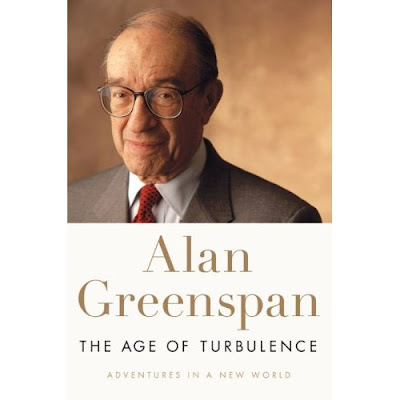
The Age of Turbulence by Alan Greenspan (2007)


Not exactly light reading. This is a serious book with some intense insights. It is clear, profound, serious, and esoteric. I think a background in economics would help with reading this endeavor from the former Federal Reserve Chairman.

Alan Greenspan is essentially writing three books within one.
One book is a personal history of his life. Another is the political history of his time working with every president since Nixon to George W. Bush, and the last, by the far the lengthiest, is a financial history of the World economy of the past thirty years with projections into the future. Each side has its own personality.

Alan, when speaking of himself, writes an endearing portrait of himself as a man who is both very emotional and very rational. He highlights mistakes in his life where being too rational or emotional had lead to the wrong decision. At best he is the embodiment of both simultaneously.

Alan Greenspan, born in New York City to a lower middle class Jewish family, grew up in the Washington Heights section of Manhattan. He really didn’t suffer through the depression, which I believe has a lot to do with his negative views of the social safety nets established by the Roosevelt administration. Although his parents divorced, his mother maintained a job as a secretary in the Bronx. His father worked on Wall Street. Alan received a 25 cent allowances growing up during the depression, which according to my grandfather was “pretty good.”

During this early period, he was more interested in music than in finance. He loved Jazz and played professionally in a band. At one point Alan got to jam with Stan Getz. While in the Jazz scene he read finance books during his downtime. He eventually left the music world got his degree at NYU, and then took a job in finance. He earned $48 a week in 1948, which again my grandfather said, “what I could have done with $48 a week in 1948.” So there you go.

Now, Greenspan took the job for $48 a week over another job for around $60 a week, because he felt he would learn more at the lower paying job than the higher. This is the kind of reasoning that he would display throughout his life.

In the 50’s, he would get married and divorced, and become part of a social group headed by Ayn Rand. Rand and her circle would up Greenspan’s game intellectually and socially. They would meet in Rand home on the East 30’s.

In the late 60’s he would meet and help out Richard Nixon in his presidential campaign. Although, he would admire Nixon for his intelligence, he grew to dislike Nixon for being a paranoid and vindictive person who would lose control.

Later Greenspan was brought on to the Ford administration. Ford was a man that Greenspan liked very much. He said was one of the most secure men he had ever met. He was not brilliantly intellectual like Nixon and Clinton, but he never had that sense of weirdness to him like so many people. There he would meet many people such as Dick Chaney, who would become part of the George W. Bush administration.
Never part of the Carter administration, he joined Washington again after a person phone from President Reagan at his dentist office. Reagan asked him to work for him and Greenspan couldn’t refuse.

Before Reagan made him Chairman of the Federal Reserve, Greenspan chaired the bipartisan committee that saved Social Security for the next thirty years. Although, Alan was impressed by Reagan convictions and personality, he didn’t think he was too smart. Like our current president, Reagan didn’t read much.

When Reagan did make Greenspan Fed Chairman, the 1988 stock market crash, the worst ever, happened. Not too long after there was the Savings and Loan sell off, and the death of the manufacturing industry in America.

Although Greenspan spoke the warmest about President Ford, the lengthiest and most enjoyable time was with President Clinton.

Although Greenspan was worried about Clinton, being that Alan was a life long Republican and campaiged for the other guy; he immediately was impressed with Clinton’s intelligence. For all the bad things that were said about Clinton Greenspan states firmly that he never saw them. Clinton was a financial conservative; more of a throw back to the Kennedy administration. It was the first president Bush’s and Bill Clinton’s economic policy of fiscal responsible that lead the economic boom in the nineties. President Reagan left the country leading to financial ruins. The deficit was the major killer. A third biggest expense to the United States government was the interest payments to its debt.

Clinton was never true of what he was called. He was not a tax and spend democrat. He cut from almost everyone, but used the money responsible and the country was on the path peace and property that the United States hasn’t known since the days Dwight D. Eisenhower.

At this period of time Alan Greenspan achieved rock star status. He would lead world into a new era; one of a technological revolution and another of pervasive globalization. The direction that he took the world will be debated for a long time. Greenspan maybe the most influential and respected American in finance since J.P. Morgan. Together with Rubin (now trying to sort of Citigroup’s finance troubles) and another colleague, Alan watched over the economy in judicious and pragmatic fashion.

The problem was that as much as Greenspan can analyze the past and near future, he had major failures in predicting the not too distant future.

Like many Republicans, Alan was very enthusiastic with the arrival of President George W. Bush. Many of Alan’s old friends from the Ford administration were coming along in the new President’s administration.

In the 2000 election, Al Gore also pledged a tax cut but a smaller one than George W. Bush. However, Gore pledged to continue to pay down the debt. Greenspan also agreed that debt should be paid down.

During the early years of the Bush Whitehouse, the surplus projections were large and spanning many years. Greenspan saw a danger of the Federal Government having too much money on their hands, so he supported a tax cut albeit smaller than the administration had outlined, and with check and balances in case the surplus didn’t hold. The administration threw out that idea.

The surplus was over almost as soon as Bush got into office. The Dot-com bust had effected tax revenue and hence no more surplus.

As time went on, Alan was dismayed by the lack of planning, reason or thought in which the current government ran. And he makes it perfectly clear over and over again that the real reason invading Iraq was oil and NOT weapons of mass destruction.

Greenspan spends the rest of his time speaking about the economy. He speaks highly of economist Adam Smith, who he admires the most. Then describes free market economies and gives economic projects for the rest of the World.

For the United States, he predicts an economy being exactly as it is right now going into 2030. Although, he admits that events unforeseen might occur, his projections mainly take world where nothing changes.
One thing we have learned over time is that things change.

Alan Greenspan takes a bird-eye view of economy. Somehow I don't get a sense that he understands the true nature of globalization in terms of the effects on the United States economy. Nobody I have heard really does. I think it is only those who are in the middle of it, in the trenches if you will, that can see what is really going on. Of course, those who negatively affected by it the most, feel it but may not know it. Those who have the most to gain, mainly foreign middlemen and those under them, give a rosy picture as do corporate executives who are profiteering from it. I would like to talk to Alan Greenspan about this and get his views. Maybe he will write another book where he will address these issues.

One my biggest criticisms of his work on free market economies is the foolish idea that social safety nets have never worked. It seems like an idea similiar to someone who doesn't take health insurance because they have never been sick before, which is taking a pretty big risk. Although, Greenspan can see the impact on the economy when huge hedge fund goes under that the Government has to bail it out in order sustain the overall health of the greater economy. He does not seem to keep in mind that if large amount of Americans go bankrupt, that too will have a far reaching negative impact on the greater economy too.

I certainly did love this book. I can’t say that it is for everyone. I think it is an important book given the times we live in. I am sure that Alan Greenspan will go down as one of the most influential economist in history.
Site Meter