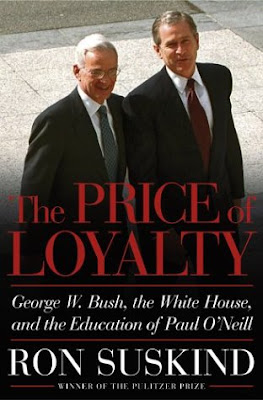
 The Price of Loyalty
 is an account of former Secretary of the Treasury, Paul O'Neill, under our President George W. Bush. Full of well researched material backing up the person account of O’Neill, it goes by very quickly as it is a personal story. It is not quite a biography. It goes in the Paul O’Neill’s past a little, but not much. If it is biographical, it is only in respect to Paul O’Neill’s life as Treasury Secretary.
Being in a cabinet post, O’Neill had very close access to President George W. Bush, and he was the first to write about it. I find the tone of this book kind of bitter, but not unjustified.
O’Neill was a very successful CEO of Alcoa, a self made man, and he had worked in the Ford administration with such people as Dick Cheney and Alan Greenspan. He grew up dirt poor and work his way up to be retired with $60 million in the bank.
He reluctantly took post of a cabinet member. He thought he might be too controversial for the Bush administration. It turns out that he was, but not for the reasons he thought he would be.
O’Neill did fit in with other member of the cabinet who would also not survive, such as Colin Powell and Christie Todd Whitman. Alan Greenspan and O’Neill were old friends.
O’Neill saw himself as a problem solver. His take was that you take away the excuses and look at something realistically; you will then find your solution. He was looking forward to doing that kind of work for the country under George W. Bush’s White House. Instead, he found something different.
One of the first things, he found was that ten days into the Bush Administration, there talk and high priority given to finding out a way to invade Iraq. Another decision was to abandon the peace process in Israel. The cabanet meetings were scripted. Everyone has their role to play with the president and no real discussion ever took place. The meetings became an echo chamber of ideologues by such people as Carl Rove, who would say such as things to the president as “Stick to Principle.” Old friend Dick Cheney had changed from the person O’Neil had known in the Ford Administration. He had become an ideologue too. Alan Greenspan, in his book, also iterated his shock and dismay over the change in Cheney. Both men acknowledged that it had been a long time since they worked with him and hence thought they knew him. Once Cheney he said he in a meeting “the one Ronald Reagan taught us was that deficits don’t matter.” O’Neil couldn’t believe what he was hearing. The one thing Ronald Reagan taught us that deficits DO matter! The deficits of the Reagan era did damage to the country. At one point, a 3rd of the United States government’s revenue went to paying the interest payments of the debt (Greenspan). It was the finical conservative discipline of the first Bush Administration and the Clinton administration that brought the United States back to financial prosperity.
During the early days of the Bush Administration, there was a ginormous (the word is in the new version dictionary - look it up) surplus forecast in tax revenue, which was coming off the Dot-com bubble. O’Neil wanted to use this money to continue to pay off the debt and solve the Social Security problem. The Bush administration was dead set on making huge tax cuts, because he had made that promise in the campaign. Now tax cuts were the idea of the day. Al Gore had also promised tax cuts during the campaign, but on a smaller level and with a commitment to continue to pay off the debt. Alan Greenspan was also in agreement of tax cuts because he feared a U.S. government with too much cash in its hands. However, Bush proposal, which the administration referred to as a stimulus package, was broad and largely irresponsible. Paul O’Neil proposed a series of triggers that would roll back the cuts in case government revenue ever reduced at a significant level. Greenspan agreed and tried to sell it. The Bush administration ignored such an idea and fought against it. In the end, the tax cuts were passed by congress with no triggers. Shortly afterwards the Dot-com bubble burst, and the country would be going back to deficits soon afterwards. Bush would get more tax cuts passed. O’Neill would argue that there isn’t much a benefit to the economy of cuts taxes to the wealthiest section of the country, because they are most likely going to be the ones to put the money away in savings. The Bush administration always took the view that the economy was worse when it was well to justify more tax cuts, which lead the country in further fiscal insolvencies.
O’Neil was probably most in the news with the tour of Africa he took with U2 front man Bono. They went on a highly publicized tour of Africa giving O’Neil a firsthand view of the situation there. He got up close and personal with the problems and saw solution that were very achievable there. He took his family with him. He came back to Washington with ideas of building wells in Africa. That plan never really went anywhere while he was in Washington. He never lost sight of the plan.
O’Neil always spoke his mind and dealt with facts and not ideologies. It eventually got him fired. Like all the other moderates in the administration, he was one of the first major posts to be replaced. O’Neil never played the political game, and it was obvious that he was mistreated. After his departure he has been called back by almost all areas of government to help on projects.
O’Neil describes Bush half a bully and half a sheep being lead my ideologues totally devoid of facts.
The Suskind book a sobering account of the Bush Administration. O'Neill was let go in 2006, so it stops there. I found it surprising rational and lucid. At this point some the ideas are known already. However, like in most cases, it good to get the source of the themes that came out of the book in order to separate from the commentary and talking points.


